

Several cases of Chikungunya or Dengue Fever have been reported on the French Riviera, with Antibes the hardest hit. This disease is transmitted by mosquito bites, specifically the tiger mosquito. UPDATE 24 Sep ’25: An FR Health Alert will be transmitted via smartphones at 10am today with advice for 11,000 people in Antibes. By yesterday, 23 September, over 100 cases had been reported in Antibes.
In an email sent last week, the Alps Maritimes CPAM (which handles healthcare expenses in France) has advised residents along the Côte d’Azur on how best to prevent being bitten, and on how to recognise symptoms.
In Antibes there have now been 103 indigenous cases. (Update 4 Oct: 115 cases.)In one family, five members were affected after visiting a playground near swampy parkland, a friend of the family told Riviera Edition. Another two cases have been reported in Nice and five in Cagnes-sur-Mer, while Frejus in the Var has 59 cases (see full lists below).
CPAM says that “hospitals, private doctors and medical analysis laboratories in the affected areas are also being mobilised” to treat, screen and inform people about preventive measures.
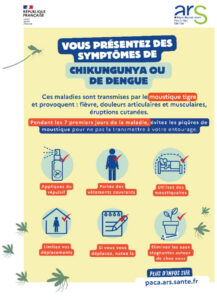
Chikungunya or Dengue Fever Symptoms
Symptoms include: fever, headache, joint and muscle pain, skin rashes, light sensitivity, fatigue.
What to Do if You Experience Symptoms
Consult a doctor immediately if you have symptoms. Or call 04 97 21 31 61.
CPAM advises that in the first seven days of the illness, one should avoid getting any other mosquito bites, as a ‘normal’ mosquito that bites an infected person could then transmit it to those around them (ie. a patient can transmit the virus to mosquitoes for up to 7 days, even if your symptoms have disappeared.)
It’s therefore vital to prevent being bitten.
To avoid being bitten by mosquitoes, CPAM advises:
- Apply mosquito repellent, especially in the morning and end of day. (Unlike malaria-carrying mosquitoes that are most active at night, tiger mosquitoes are most active during the day, particularly at dusk and dawn, according to the NHS.)
- Wear loose clothing that covers your skin
- Use mosquito nets around beds for newborns or bedridden people
- Limit your movements
- If you go out, keep a record of where and when
According to the UK’s NHS website “while most people recover fully within 1 to 2 weeks, the joint pain can persist for months or even years in some cases, with up to 12% of patients still experiencing discomfort 3 years after infection.”
How to prevent mosquitoes multiplying
- Eliminate stagnant water around your home (that’s where mosquitoes lay their eggs).
- Empty pot plants and anything else (like garden furniture) that retains small amounts of water, at least once a week.
- Make sure toys, buckets, watering cans are stored away when it rains.
- Cover water reserves with mosquito netting.
CPAM says it does not recommend using insect repellent bracelets, essential oils, ultrasonic sound devices, tapes, papers and sticky stickers that have not been proven effective.
The following towns on the Riviera have reported Chikungunya mosquito bite cases (19 Sep):
- Antibes – 87 (now 103)
- Auribeau-sur-Siagne – 1
- Cagnes-sur-Mer – 5
- The Guade – 6
- Nice – 2
- Vallauris – 2
In the Var, the following towns have been affected by Chikungunya or Dengue Fever cases:
- Bauduen – 3
- La Crau – 2 (end of circulation of the virus in the area)
- Frejus – 59
- Ollioules – 1
- Roquebrune-sur-Argens – 1
- Rougiers – 1
- Sanary – 1 indigenous case of Dengue Fever (end of circulation of the virus in the area)
- Toulon – 1 (end of circulation of the virus in the area)
- The Valmer Cross – 3
Find out more at:
paca.ars.sante.fr

