

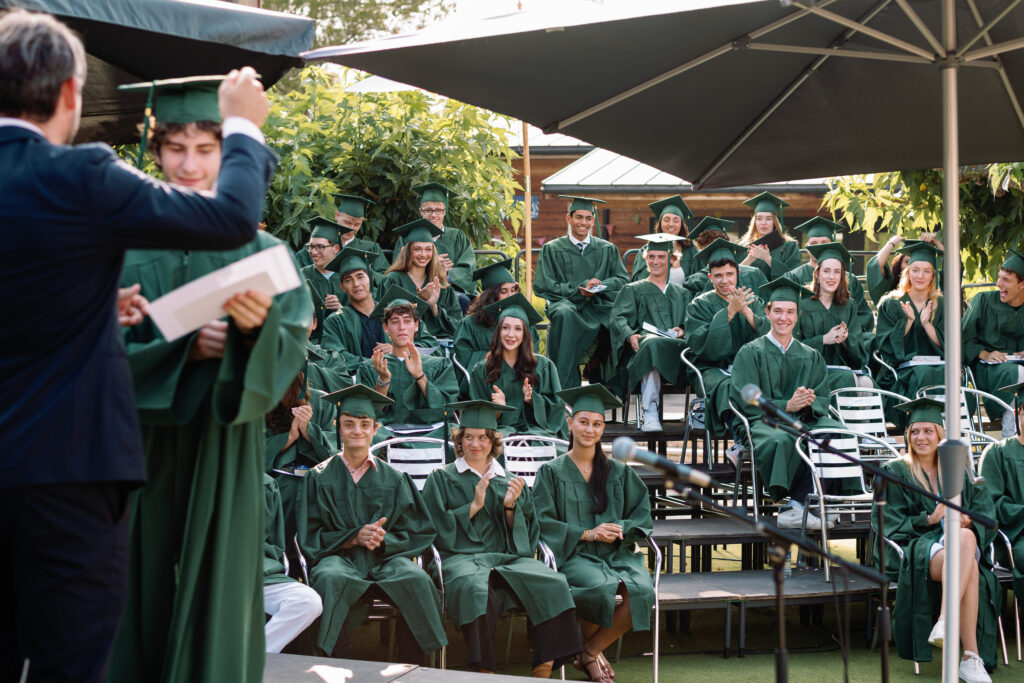
With the school year at Mougins School about to come to an end, we thought it would be a good time to catch up with a few of its students, as they are embarking on the next stage of their educational journey, to find out what makes Mougins School so special. We spoke to Lea, who is going to study at prestigious Sciences Po Paris, Andrea, who is off to study Law LLB at UCL (University College London) and Anaïs, who is considering taking a gap year before starting Fashion Photography studies.
Why Students Love Mougins School
1. In what ways do you feel the school has prepared you academically and personally for the transition to university life?
Lea: I believe that the transition into sixth form prepares students for the transition to university life on both a personal and academic level. Entering sixth form represents a significant change for students, as the focus shifts to a small range of subjects, allowing students to gain greater expertise in each subject area. In sixth form, students are encouraged to take responsibility for their own learning both within and outside of school, which I believe prepares students to balance their academic workload with their personal life at university.
Andrea: Mougins School has always encouraged me to push myself, both academically and personally. Through its challenging academic environment, I have learned how to manage my time effectively, think critically, and work independently. At the same time, the supportive and international community helped me become more confident, adaptable, and open-minded. These experiences have prepared me not only for the academic demands of university life, but also for the personal independence and responsibility that come with it.
Anaïs: Mr Michael and Ms Kench had an immense impact on my preparation and transition to university life. Because I took creative subjects, one of the main things is to talk and get advice from your teachers to further your creative ability and therefore your work. Their criticism and support made me more creative. The fact that I had them as teachers for so many years helped me learn a bit about their ways of thinking which I think played a crucial part in how I think and work now.
2. Which teachers, subjects, or extracurricular activities influenced you the most, and why?
Lea: Ms McCosker, who was my maths teacher, had a very effective teaching style which influenced the way I studied maths as well as my other subjects independently. Her consistent assignments and approach to teaching really helped me to master various complex topics and helped me find my own way of studying independently. Her emphasis on repetition and understanding topics fully has been incredibly effective. Additionally, taking economics at A Level with Ms Kellie greatly influenced me and my decisions surrounding university courses, as I felt for the first time that what I was learning in school was directly applicable to what I read about in the news and allowed me to understand complex discussions which previously seemed foreign to me.
Andrea: I have always been very passionate about English Literature because I find it to be a more creative and open subject, allowing for each individual to interpret elements of novels and poems in their own way whilst also taking account of the author’s influences.
My passion started when I was in Year 9 because of my English teacher’s thoughtful and entertaining approach to the subject, inspiring the entire class to engage more deeply with literature and think critically about the themes and messages behind each text.
Since then, I have moved on to A-Level English Literature which has allowed me to explore my passion for this subject at a far higher level – either through exploring critical approaches to novels, as well as diving into the technical aspects of terminology, all fuelled by the unwavering support of my teachers.
Anaïs: I would say that media studies has influenced my way of thinking a lot. When I look at a media text I automatically analyze certain conventions. It has helped me appreciate film and art on another level. Mr Michael helped me a lot when it came to seeing my worth. When I was younger, I wasn’t really seen as a smart kid and no one really expected a lot from me, at least not academically. In the past few years that has really changed because I was doing a subject I was genuinely so interested in and passionate about. Mr Micheal played a huge part in that.
3. How has your experience at an international school shaped your global perspective, and what do you think makes your school experience unique as you head to university?
Lea: My time spent at such an international school has provided me with a global perspective, as I was constantly surrounded by a range of cultures, languages and viewpoints. Studying at Mougins School allows students to gain an understanding of different cultures and traditions, particularly during school events such as International Day. Although we follow a British curriculum, teachers consistently keep a global perspective in mind. I think what is most unique about Mougins School is how tightly knit the community is. As the school is relatively small, students across all age groups are able to connect and help each other. Students are also able to receive individual attention from teachers, as class sizes are relatively small. I would describe the school as the stark opposite of anonymous, as there is a genuine sense of care and appreciation among students and teachers.
Andrea: Spending time at an international school has helped me become more open-minded, adaptable, and confident in communicating with people from different backgrounds. The school also celebrates its international community through events such as International Day, where students and parents represent their countries by sharing traditional food, games, and cultural activities. What makes the Mougins School experience unique is its supportive and diverse environment, which has encouraged me to grow both academically and personally while preparing me well for university life.
Anaïs: I come from a small city in Switzerland and I still have friends from there whom I am still very close to. One of the most interesting things from the past few years for me was to see not only how people behave but also their political and social views on things. And how they differ from each other depending on where they come from. And the fact that I experienced how so many people all have different views of the world and the people in it really helped me shape my own view of the world. Because Mougins School is so international, it made my experience there so unique as I now have friends who come from so many different countries. I think that being part of an international school is one of the best things because it broadens your horizons, influences who you become as a person and is one of the key things that gets you prepared for university.
4. As you’re about to graduate, looking back on your time at Mougins British International School, what moments have had the biggest impact on who you are today?
Lea: I think the moments that have had the biggest impact on me have been conversations with my teachers, as well as their consistent feedback and encouragement. Throughout the years, all my teachers have made concerted efforts to engage with and get to know students on an individual level. In recent years, I have found it extremely helpful and impactful to have conversations with my teachers about the topics that interest me and to hear their opinions and feedback on my work. Through this consistent communication, I have been able to discover and develop my academic strengths, which has ultimately helped me to choose my university path.
Andrea: Having spent 15 years at Mougins School, there are countless memories I will cherish forever. My early years in primary school always make me smile, especially the kind and caring teachers who encouraged us to become better learners from day one, including one who even ran a cooking class every Wednesday afternoon (I still use some of those recipes today!). My time as Head Girl has also been especially formative, teaching me what it truly means to lead, the responsibility that comes with it, and the importance of working closely with people I might not have connected with otherwise. Above all though, it is the exceptional people I have met along the way, both students and teachers, that will stay with me long after I leave.
Anaïs: Some of my most cherished memories actually happened in the nurse’s office. Her office was probably the place where I spent a lot of my time time because in middle and high school there are obviously moments of doubt not only academically but also socially. The nurse, Ally Vibert helped me through a lot of my issues and conflicts. And she really influenced me and who I have become as a person in the past few years.
5. Finally, if you could give one piece of advice to younger students at the school, what would it be?
Lea: My biggest piece of advice to younger students at the school would be to take accountability for their own learning. Although teachers are highly dedicated, it’s important to pursue subjects outside of school hours in order to progress and reach your full potential. This applies especially to students entering sixth form, as this is a period when students are expected to take responsibility for their learning and seek out help when they feel that they could benefit from additional support. I would definitely recommend that students don’t hesitate to ask questions and ask for help, as teachers are always happy to provide any additional support they may need.
Andrea: Finally, if I could give one piece of advice to younger students at the school, it would be to make the most of their time and not rush into growing up too quickly. Enjoy the opportunities and support available to you in your early years, but also remember to stay curious and be driven by knowledge, even at a young age. The more you engage with learning now, the more confident and prepared you will be for the challenges that come later!
Anaïs: One piece of advice to younger students would be that this is just the beginning of everything and that this experience at Mougins School should be cherished but it does not define who you are. These memories and experiences only help you further yourself and who you will become in the future. I always say that middle school and high school are actually just your primary school of life if that makes sense. Because as soon as you graduate, that’s when your life actually starts. And because of Mougins School you will have so many options regarding what the next steps into the future will look like.
To find out more and to BOOK A VISIT, please call 04 93 90 15 47 or click here.
Please note: Mougins School remains open all summer for visits.

