

Due to the ongoing dry conditions in the Alpes-Maritimes region of France, 13 new municipalities are now subject to water restrictions as of yesterday, Saturday 25 July 2026, bringing the total to 43.
The Alpes-Maritimes department announced in a press release that it is activating these new measures in order to preserve current water resources in the territory.
Municipalities in Crisis (the strictest restrictions) include Saint-Paul-de-Vence while Antibes is on Heightened Alert and Cannes, Valbonne and Vallauris are on Alert.
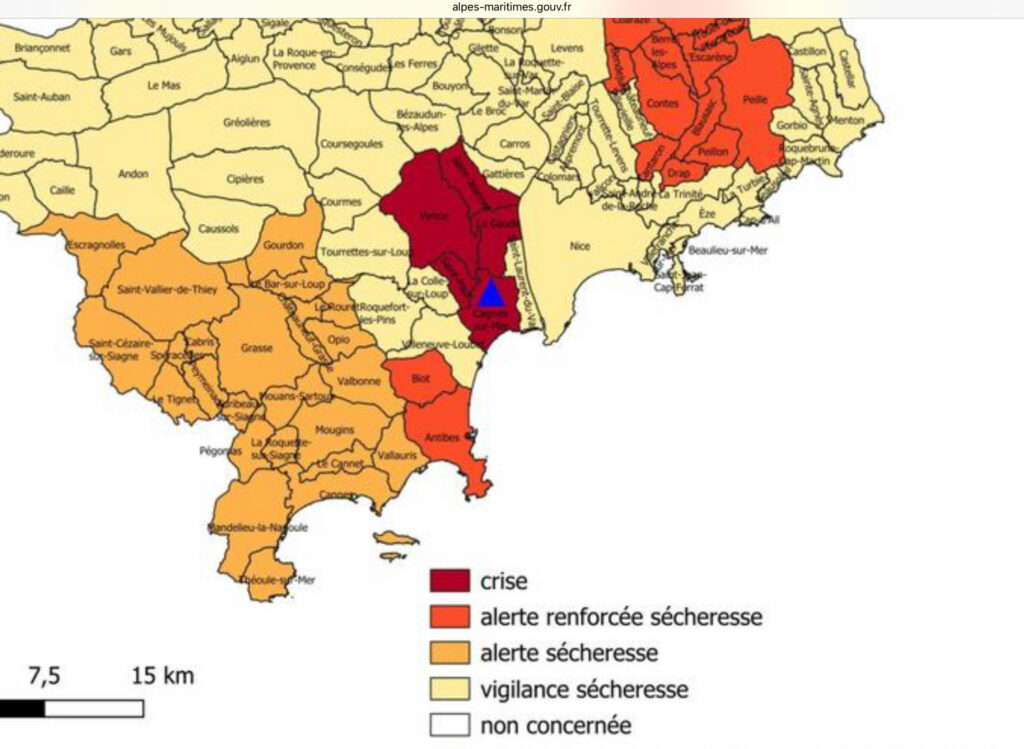
The municipalities (24) on ALERT are:
Restrictions including being banned from washing cars or filling private swimming pools affect several towns on the Côte d’Azur including Grasse, Theoule, Cannes, Vallauris, Mougins, Le Rouret, Opio and Valbonne.
- Upper Siagne catchment area: Cabris, Escragnolles, Grasse, Peymeinade, Saint-Cézaire-sur-Siagne, Saint-Vallier-de-Thiey, Spéracèdes, Le Tignet.
- Lower Siagne catchment area: Théoule-sur-Mer, Mandelieu-la-Napoule, Cannes, Le Cannet, Vallauris, Mougins, La Roquette sur Siagne, Pégomas, Auribeau-sur-Siagne, Mouans-Sartoux.
- Municipalities in the Loup watershed due to the double zoning with the upper Siagne: Gourdon, Le Bar-sur-Loup, Le Rouret, Opio, Châteauneuf-Grasse, Valbonne.
What are the water restrictions for areas on alert in the south of France?
- Washing cars at home is banned
- Filling private swimming pools is banned
- Water green spaces, flowerbeds, vegetable gardens and golf courses is prohibited during the day (8am to 8pm)
View more details here.
The municipalities (14) on HEIGHTENED ALERT:
Antibes and Biot on the French Riviera are amongst those towns on heightened alert, where not only filling private swimming pools and washing cars at home is banned, but the watering of green spaces and flowerbeds is banned too, day and night.
Brague catchment: Antibes, Biot.
Paillons catchment: Bendejun, Berre-les-Alpes, Blausasc, Cantaron, Coaraze, Contes, Drap, l’Escarène, Lucéram, Peille, Peillon, Touët-de-l’Escarène.
Water restrictions for Antibes, Biot and others on Heightened Alert
- Washing cars at home is banned
- Filling private swimming pools is banned
- Watering green spaces and flowerbeds is banned (day and night)
- Golf courses are required to reduce their watering volumes by 60% (which is only possible at night)
- Beach showers are closed
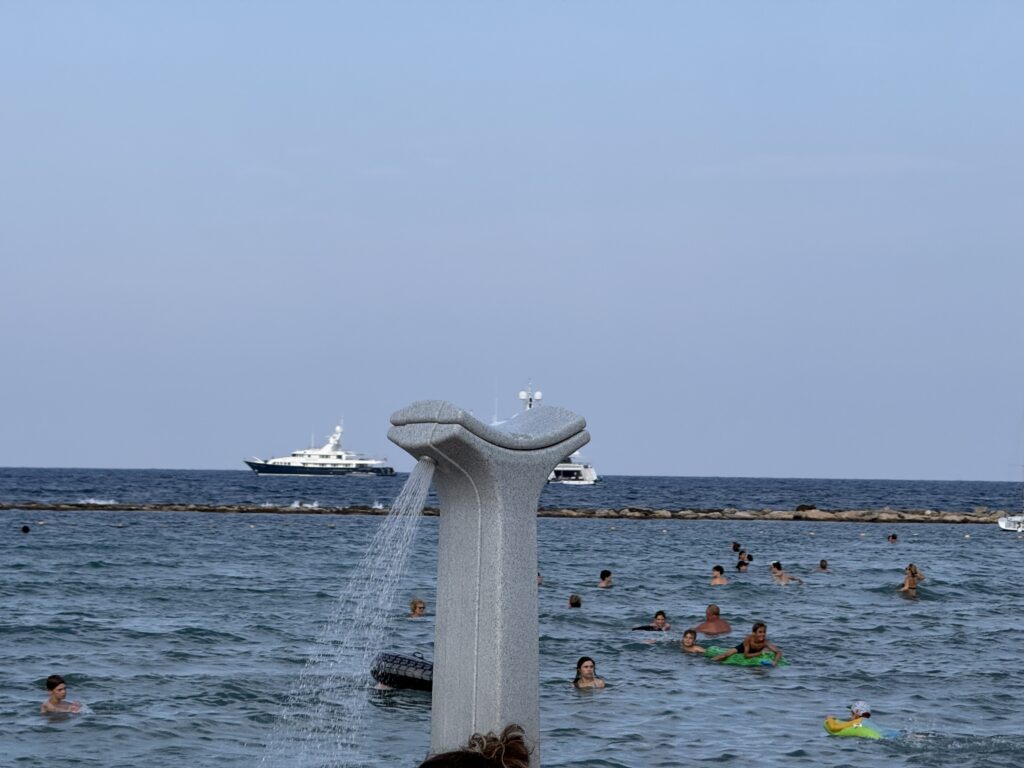
Restrictions are also being applied to agricultural, industrial and craft activities, in order to save water and “in a spirit of solidarity between all inhabitants and sectors of activity”, said the department.
View more details here.
The Municipalities (5) in CRISIS
- Cagne catchment area: Cagnes-sur-Mer (only for uses not connected to drinking water*), La Gaude, Saint-Jeannet, Saint-Paul-de-Vence, Vence.
*Since Cagnes-sur-Mer imports all of its drinking water from the Loup river basin, uses connected to drinking water are subject to the measures for the Loup basin, which is currently ‘only’ at the alert level.
Water restrictions for municipalities in Crisis
- Topping up private swimming pools is prohibited
- Washing cars at home is prohibited
- Watering vegetable gardens and green spaces day and night, except in specific circumstances, is prohibited
- Car washes without a recycling system are closed
- Golf courses are prohibited from watering except under specific conditions
As above, restrictions also apply to agricultural, industrial, and artisanal activities.
Other municipalities remain under DROUGHT ALERT
The other municipalities in Alpes-Maritimes remain under drought alert, which has been in effect since 1 June 2026.
What restrictions are there in ‘Drought Alert’ municipalities?
While there are no water restrictions for these municipalities, people in those regions are encouraged to conserve water by adopting co-operative practices, in order to prevent – or at least delay – restrictions.
What has caused the drought conditions on the French Riviera?
The Alpes-Maritimes department explains that there has been a persistent and “alarming meteorological and hydrological situation” for several months:
- A rainfall deficit of nearly 15.5% since September 2025
- 81% of monitored groundwater levels are below seasonal norms
- Excessive temperature anomalies of +2.9°C in June and +3.8°C in July. April 2026 was the second warmest April since 1947, while June and July were marked by significant heat waves.
The department said there has been a significant decrease in the flow of coastal rivers and an early appearance of dry areas in some zones.
Meanwhile in the highlands, the accumulated snow and rain allowed the flow rates to remain above the alert thresholds in the spring, and with storms in June, the water resources in the Var have been supported.
The department also noted that there has been an increase in water consumption – in some areas more than 30% – since April, putting pressure on the available resources.
What are the prospects for the drought ending soon on the Côte d’Azur?
The national weather bureau predicts a hotter than normal summer season, which the region has already been experiencing since the end of May.
The department says: “As a reminder, temperature is a key factor in maintaining sufficient water levels and limiting evaporation and evapotranspiration. Rising temperatures, coupled with decreased flow rates, lead to increased water temperature in rivers and streams, significantly impacting the flora and fauna that thrive there.
“Due to the evolving situation observed by government agencies, new restrictions on water withdrawal and consumption are expected in the coming weeks.”
Discover eco-friendly practices to reduce your water consumption at https://vigieau.gouv.fr/

